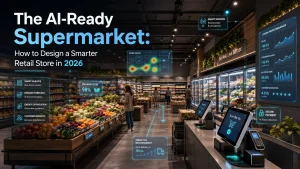
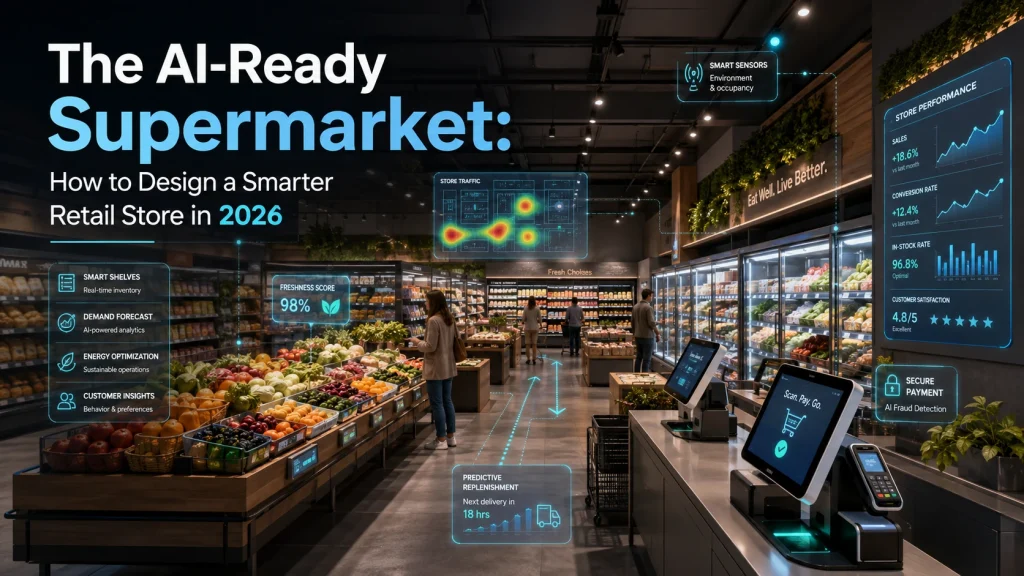
The AI-Ready Supermarket: How to Design a Smarter Retail Store in 2026
A practical guide to creating supermarkets that can support intelligent refrigeration, computer vision, electronic shelf labels, predictive replenishment and better real-time decisions—without sacrificing the human shopping experience.
Artificial intelligence is changing retail, but the smartest supermarket is not necessarily the one with the most screens, cameras or software subscriptions. It is the store whose layout, power, data, refrigeration, equipment and operating processes were designed to work together.
That distinction matters. Many retailers try to add technology after the store has already been built. They discover that sensors cannot see the right zones, refrigeration systems do not share usable data, network coverage is inconsistent, electronic labels are difficult to manage, or staff workflows were never designed around real-time alerts. The result is a collection of isolated tools rather than an intelligent store.
An AI-ready supermarket is not a technology showroom. It is a flexible retail environment that can sense what is happening, interpret the information and support faster, better operational decisions.
The objective is measurable store performance—not technology for its own sake.Retail leaders are now moving beyond isolated AI pilots toward connected systems and real-time operations. At the same time, physical stores remain responsible for trust, product discovery, freshness, service and human connection. The opportunity in 2026 is therefore not to replace the store experience with automation, but to create a store where intelligence quietly improves availability, efficiency, comfort and customer flow.
Connected operations
Store systems share reliable data instead of operating as isolated islands.
Real-time visibility
Teams can detect stock, temperature, queue or equipment issues sooner.
Human-centred action
Technology helps staff make better decisions and serve customers faster.
What Does “AI-Ready Supermarket” Actually Mean?
An AI-ready supermarket is a store designed so that data can move from physical operations into useful decisions. Sensors, point-of-sale systems, cameras, refrigeration controllers, digital price labels, loyalty platforms and inventory tools may all contribute information. AI can then identify patterns, forecast demand, detect exceptions or recommend actions.
The key word is ready. A retailer does not need to activate every system on opening day. The building and store plan should simply avoid blocking future upgrades. That means allowing enough power, connectivity, equipment access, technical space and layout flexibility to adopt new tools without rebuilding major parts of the store.
An ordinary connected store
- Has several digital systems
- Collects data in separate platforms
- Relies on manual checking and reporting
- Upgrades technology area by area
- Often reacts after problems occur
An AI-ready store
- Uses a coordinated data and infrastructure plan
- Connects operational systems where useful
- Designs workflows around alerts and exceptions
- Can pilot and scale technology by module
- Uses prediction to act earlier
Why Store Design Must Come Before the Technology
AI depends on the physical store. A camera cannot understand customer movement if sightlines are blocked. A shelf-monitoring system cannot perform consistently if merchandising structures change unpredictably. Smart refrigeration cannot optimize energy or maintenance when controllers, valves and sensors are not integrated into a clear technical architecture.
This is why the AI conversation should begin during supermarket planning and fit-out—not after installation. The layout team, MEP engineers, refrigeration specialists, equipment supplier, IT team and store operations team should agree on the intended use cases before finalizing the infrastructure.
The future intelligence of a supermarket is limited by the decisions made before the first shelf, cable or refrigerated cabinet is installed.
Dina Group retail design perspectiveEight Foundations of an AI-Ready Supermarket
A flexible customer-flow plan
The store must remain easy to navigate even as categories, promotions and technology change. Clear sightlines, adaptable gondola runs, logical adjacencies and sufficient decision space make both human shopping and digital analysis more reliable.
Layout intelligenceA resilient power and data backbone
AI systems require stable connectivity, structured cabling, protected power, suitable network coverage and technical access. Spare capacity and clearly documented routes make future sensors, displays and edge devices easier to add.
MEP + IT coordinationConsistent shelf and product visibility
Computer vision and shelf analytics work best with disciplined planograms, predictable shelf geometry and clear product presentation. Adjustable but standardized supermarket shelving supports both merchandising flexibility and reliable data capture.
AvailabilityConnected refrigeration
Refrigeration is one of the most valuable areas for intelligent monitoring. Temperature, pressure, door status, defrost cycles, alarms and energy data can help teams detect abnormal performance earlier and prioritize maintenance.
Cold-chain performanceElectronic shelf-label readiness
Digital labels can reduce manual price changes and support faster promotions, but they require disciplined product data, wireless coverage, label mounting compatibility and clear ownership of price accuracy.
Dynamic pricingObservable customer journeys
Queue length, dwell time and traffic patterns can reveal friction points. The goal is not constant surveillance; it is privacy-conscious measurement that helps improve checkout capacity, wayfinding and service deployment.
Customer flowOperationally useful dashboards
A dashboard should show what requires action—not simply display more numbers. Alerts must be prioritized, assigned and connected to staff responsibilities, service procedures and maintenance escalation.
Decision designModular systems and open integration
Retail technology changes quickly. Selecting systems with documented interfaces, exportable data and modular architecture reduces dependence on one vendor and makes future expansion more practical.
Future scalabilityThe Five-Layer Architecture of a Smart Supermarket
Retailers often focus on the visible technology, but the most important intelligence sits beneath the surface. A practical AI-ready store can be understood as five connected layers.
From physical activity to useful action
Each layer must be designed with the others in mind. Weak data at the bottom produces weak decisions at the top.
Where AI Can Create Real Supermarket Value
1. Demand forecasting and replenishment
AI forecasting can combine sales history with variables such as seasonality, promotions, local events, weather and lead times. The potential benefit is not “perfect prediction”; it is a more disciplined starting point for ordering and replenishment decisions. Store layout still matters because staff need short, practical routes from receiving and back-of-house storage to the selling floor.
2. On-shelf availability
Computer vision, weight sensors or staff-scanning tools can help identify gaps, misplaced products or planogram exceptions. The system becomes valuable only when an alert reaches the right person and the replacement stock is accessible. For that reason, shelf intelligence must be planned together with storage capacity, aisle width and replenishment workflow.
3. Predictive refrigeration maintenance
Connected commercial refrigerators, freezer cabinets and cold rooms can provide a continuous picture of system behaviour. AI can help detect unusual patterns and direct technical teams toward equipment that deserves inspection. This is especially relevant because refrigeration is commonly the largest energy load in a supermarket.
4. Energy optimization
AI can coordinate temperature setpoints, defrost timing, lighting schedules, HVAC conditions and occupancy patterns within safe operational limits. The purpose is not aggressive energy reduction at the expense of food safety or comfort. It is to identify avoidable consumption and manage the store as one connected energy system.
5. Checkout and queue management
Traffic data can help predict when queues will form and when an additional checkout should open. The physical front-end design must support this flexibility with adequate queue space, clear guidance, appropriate checkout counters and a balanced mix of staffed, express and self-checkout options where suitable.
6. Personalization and retail media
Retailers are increasingly using customer data and AI to improve recommendations, offers and communications. Inside the store, personalization should remain useful and subtle. Digital signage, loyalty applications and relevant promotions can support discovery, but they should never make the environment feel chaotic or intrusive.
The Human Store Still Matters
The rise of AI does not reduce the importance of good retail design. It increases it. When routine decisions become faster, customers notice the physical experience even more: whether fresh food looks attractive, whether the aisles feel comfortable, whether products are easy to find, whether staff are available and whether checkout feels effortless.
Successful supermarket design therefore balances three forms of intelligence:
Machine intelligence
Detects patterns across large volumes of operational data and highlights exceptions that humans may not see quickly.
Human intelligence
Understands context, builds trust, handles unusual situations and provides service that cannot be reduced to a data point.
Spatial intelligence
Uses layout, lighting, zoning, visibility and equipment placement to make the store naturally easier to shop and operate.
The winning combination
Technology works quietly in the background while the customer experiences a fresher, faster, clearer and more dependable store.
A Practical Roadmap: From Conventional Store to AI-Ready Store
Define the business problems
Start with issues such as stockouts, refrigeration alarms, high energy use, long queues, weak promotional execution or inconsistent pricing. Do not begin with a technology catalogue.
Map systems, data and workflows
Document what information already exists, who uses it and what action should follow. Identify gaps between operations, IT, maintenance and store management.
Design the physical infrastructure
Coordinate layout, MEP, structured cabling, equipment controls, lighting, signage, sensor positions and technical access before construction. Use 3D supermarket design to test visibility and spatial implications.
Pilot one measurable use case
Select a defined zone or workflow. Establish a baseline, success criteria, staff responsibility and a realistic review period.
Integrate and scale carefully
Connect successful systems to broader store operations. Standardize documentation, training, cybersecurity and maintenance before expanding across branches.
Keep optimizing after opening
An intelligent store is never “finished.” Review data quality, false alerts, staff adoption, customer experience and changing business priorities.
AI-Ready Supermarket Design Checklist
| Area | Questions to resolve before fit-out | Why it matters |
|---|---|---|
| Store layout | Are sightlines, aisle widths, category zones and replenishment routes clearly planned? | Improves customer flow and the reliability of visual or traffic analytics. |
| Power | Is there protected capacity for future sensors, gateways, labels, displays and edge devices? | Prevents disruptive rewiring and uncontrolled extensions. |
| Connectivity | Is coverage tested across shop floor, cold rooms, receiving, checkout and technical areas? | Connected devices are only useful when communication is stable. |
| Refrigeration | Can controllers, alarms and energy data be accessed in a structured and secure way? | Supports monitoring, faster diagnosis and future optimization. |
| Shelving | Are fixtures modular, planograms disciplined and label systems compatible? | Supports shelf analytics, merchandising changes and digital pricing. |
| Checkout | Can lanes flex between staffed, express and self-service needs? | Allows queue management systems to translate insight into action. |
| Data | Who owns each data source, and can systems exchange or export usable information? | Reduces data silos and vendor lock-in. |
| Privacy | Is collection proportionate, secure, transparent and compliant with local requirements? | Protects customer trust and reduces legal or reputational risk. |
| Operations | Who receives alerts, what action is expected and how is completion recorded? | Turns intelligence into consistent execution. |
| Scalability | Can the solution be piloted, measured and expanded without rebuilding the store? | Keeps investment controlled and adaptable. |
How to Measure Whether the Smart Store Is Actually Working
Retailers should measure operational outcomes rather than the number of installed devices. Every AI project needs a baseline and a clearly assigned owner. Suitable indicators depend on the use case, but may include:
A system that creates many alerts but no action is not intelligent. A system that saves staff time in one department while adding complexity elsewhere may not create net value. The best projects improve the complete operating model.
What Retailers Should Not Automate Blindly
AI can improve consistency, but supermarkets operate in the real world—where products move, customers behave unpredictably, sensors fail and unusual situations occur. Human review remains essential for food safety, pricing exceptions, security incidents, customer complaints and decisions that significantly affect people.
Retailers should also avoid collecting data simply because it is technically possible. Privacy, cybersecurity and governance must be designed into the project. Use the minimum data required for the stated purpose, control access, document retention and ensure vendors meet appropriate security expectations.
The safest AI strategy is modular, measurable and reversible: pilot carefully, keep humans accountable and scale only after the operational value is clear.
How Dina Group Designs for the Next Generation of Retail
An AI-ready supermarket requires coordination across disciplines that are often treated separately. Dina Group brings retail consultation, 2D planning, 3D visualization, MEP coordination, refrigeration, shelving, checkouts, lighting, fit-out, installation and after-sales support into one project journey.
This integrated approach allows technical decisions to be tested against the real store experience. Camera positions can be reviewed against signage and sightlines. Refrigeration data requirements can be coordinated with the cooling system. Digital labels can be considered when selecting shelf profiles. Checkout technology can be aligned with queue space, ergonomics and customer behaviour.
The result is not a futuristic concept that looks impressive but is difficult to operate. It is a buildable retail environment designed for today’s requirements and tomorrow’s upgrades.
Planning a supermarket that needs to stay competitive for the next decade?
Start with the layout and infrastructure. Dina Group can coordinate the store plan, equipment, refrigeration and fit-out around your current operating model and future technology roadmap.
Frequently Asked Questions
What is an AI-ready supermarket?
Does a small supermarket need AI infrastructure?
Which supermarket area benefits most from AI?
Can AI reduce supermarket energy consumption?
Should AI systems be planned before supermarket fit-out?
How should a retailer begin an AI supermarket project?
Editorial sources and further reading
This article combines Dina Group’s retail design perspective with current industry and technical guidance.
- National Retail Federation — Retail trends and predictions for 2026
- National Retail Federation — Scaling AI and real-time retail operations
- Deloitte — 2026 Global Retail Industry Outlook
- IBM — AI in retail applications and operating models
- U.S. Department of Energy — Supermarket refrigeration energy efficiency
Dina Group
Turnkey retail design, supermarket equipment, refrigeration, shelving, shop fit-out, installation and after-sales support across the UAE, GCC and international markets.